




More than 2,500 GW of renewable generation, large electrical loads and storage projects are stalled in connection queues worldwide, according to the International Energy Agency. Building networks remains essential, but transmission projects often take much longer than solar generation, batteries, charging infrastructure or new industrial loads.
The IEA estimates that annual grid investment needs to rise by about 50% from today’s level of roughly USD 400 billion by 2030. It also identifies measures that can use existing infrastructure more efficiently while long-term reinforcement is planned and built.
A battery can support the connection, not only the building
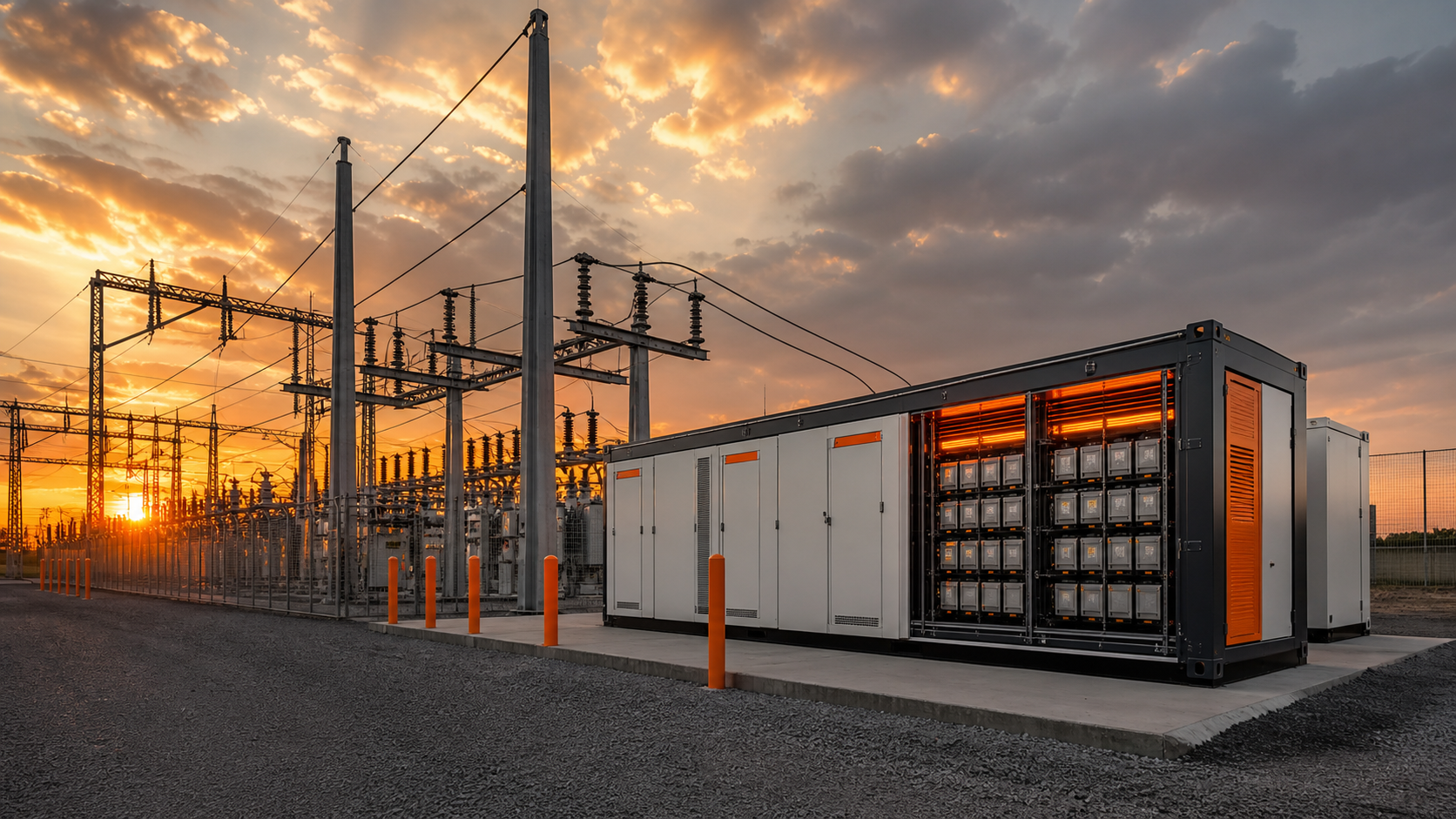
Most customers first see a battery as a way to move their own solar production from one hour to another. At network scale, storage can also relieve a constrained line, absorb generation that would otherwise be curtailed and provide controlled power during a congested period. The IEA describes storage as a transmission asset as one of several grid-enhancing approaches.
This role requires a controller that responds to network conditions, not only to the customer’s state of charge. The commercial arrangement must define when the battery is available, which party controls it, what energy reserve belongs to the customer and how repeated cycling is valued.
Connection agreements can create capacity sooner
A non-firm connection can permit generation, load or storage to connect earlier on the condition that output or consumption may be restricted at specific times. The IEA estimates that conditional agreements could unlock 750–900 GW of advanced projects now waiting in global queues, while technical grid upgrades could enable additional capacity.
Co-locating photovoltaics, batteries and controllable demand at one connection point can also help. These assets do not all need maximum capacity at the same moment. A coordinated controller can respect the site limit while deciding whether energy should be exported, stored as electricity, stored as heat or used immediately.
Storage is one part of a larger grid toolbox
Dynamic line and transformer ratings can calculate capacity from actual operating conditions. Advanced power-flow control and topology optimisation can redirect electricity through the network. Reconductoring and voltage uprating provide more substantial physical upgrades. These measures have different costs, lead times and firmness, so their potential cannot simply be added together.
The IEA estimates that selected grid-enhancing technologies could unlock 450–700 GW of projects in advanced connection queues. Storage as a transmission asset is shown with a possible 30–40% capacity increase in suitable applications and a typical implementation lead time of two to three years, but actual results always depend on the specific network constraint.
What this means for a smaller installation
A household or business will not operate a transmission network, yet the design principle is the same. Equipment should be evaluated at the connection point. The useful questions are how much power may flow, when the limit applies, how fast control can react and which loads can be shifted without reducing service.
An oversized battery does not automatically solve a power constraint. Charging power, available headroom, forecast generation and the battery’s current state determine whether it can absorb a peak. Thermal storage can provide another controllable destination where the final demand is heat.
Plan the control rules before buying capacity
- Record import and export power at a suitable time interval.
- Separate fixed loads from flexible electrical and thermal demand.
- Define the minimum backup reserve before offering grid flexibility.
- Check the inverter’s response speed and external-control interfaces.
- Model winter and summer operation separately.
- Confirm who carries the cost of additional cycling and degradation.
New lines remain necessary, but storage can make the waiting period more productive and existing infrastructure more useful. The equipment decision should therefore start with the operating rules of the complete site, not with the largest battery that fits in the room.
Primary source: International Energy Agency — Electricity 2026: Grids · source language: English · published: 2026-02-06. This is an original WodaTherm™ briefing, not a copy of the source publication.