





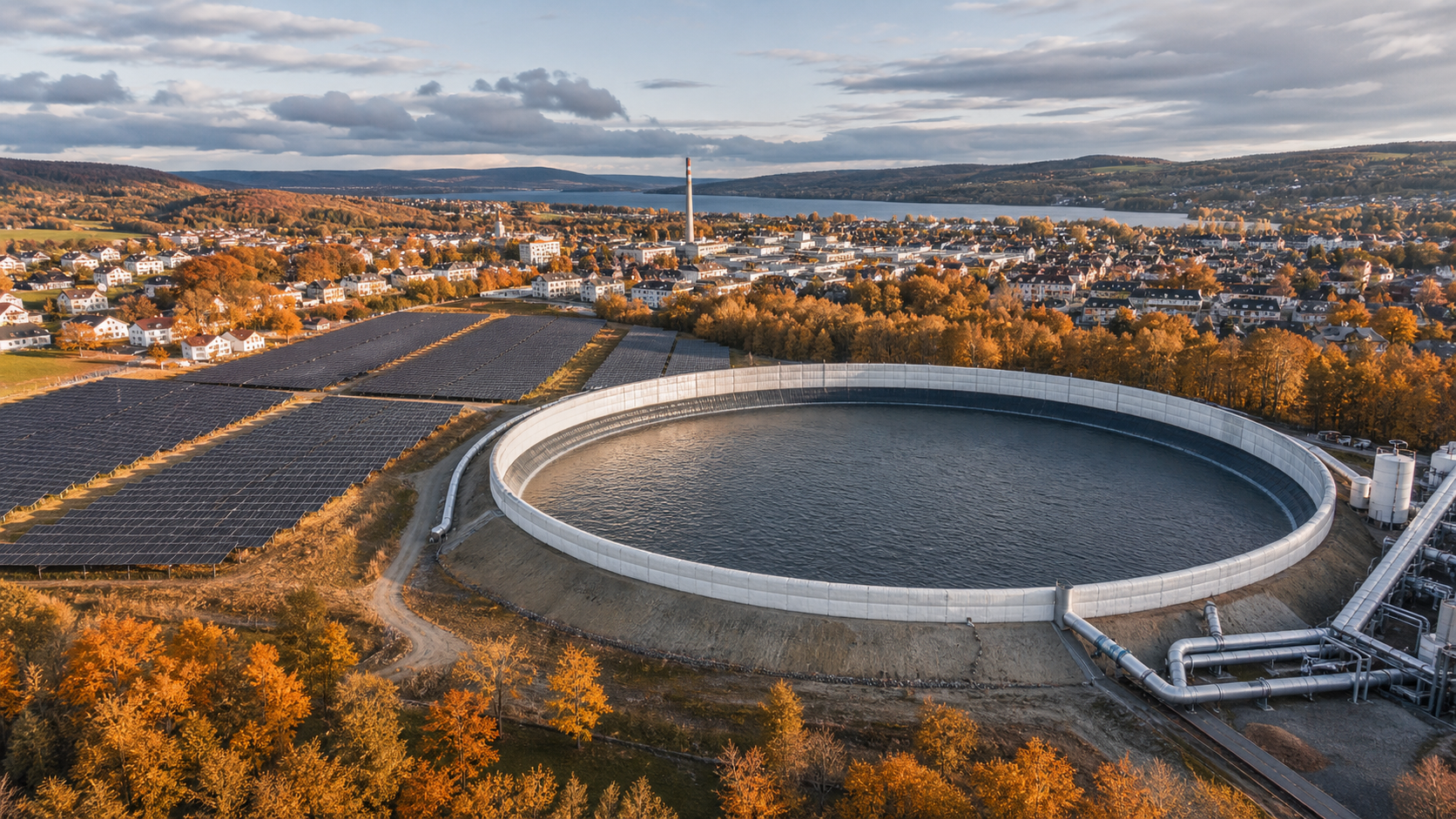
Heat is often available at a different time from when people need it. Solar thermal output peaks in bright hours, industrial processes may release recoverable heat continuously and electricity prices can fall when renewable generation is abundant. Thermal storage connects those supply windows with later demand.
The International Energy Agency estimates that district-energy networks serve about 600 million people. Its 2026 guidance describes storage as a key tool for integrating renewable and recovered heat, with storage periods ranging from hours and days to whole seasons.
One principle, several scales
A district network may use a very large water tank, pit storage, boreholes or aquifers. A commercial building may use buffer vessels or solid thermal media. A home may use hot-water storage or an electric storage heater. The scale and engineering differ, but the basic task is the same: charge when energy is available and release it when the user needs heat.
Short-duration storage handles daily peaks. Longer storage can retain part of summer heat for a colder period, although heat losses, geology and capital cost become more important as the storage interval grows.
Temperature determines usefulness
A useful thermal store is not specified by volume alone. Engineers must know the usable temperature range, insulation performance, charge and discharge power, heat-exchanger design and the temperature required by the final load. Low-temperature networks can use sources that would be unsuitable for older high-temperature systems.
Smart controls then coordinate sources and storage. Weather forecasts, demand forecasts and electricity prices can help decide whether to charge now, retain capacity or use another source. The result is a system decision rather than a collection of separate appliances.
What smaller projects can learn
- Start with heat demand and required delivery temperature.
- Calculate usable stored heat within the permitted temperature window.
- Include standing losses over the expected storage period.
- Match electrical input power to the available surplus and connection.
- Keep controls, sensors and service access in the design from the beginning.
Seasonal storage will not suit every site, but the broader lesson applies everywhere: electricity, heat source, storage and control should be designed as a single energy system.
Primary source: International Energy Agency · source language: English · published: 2026-06-10. This is an original WodaTherm™ briefing, not a copy of the source publication.