





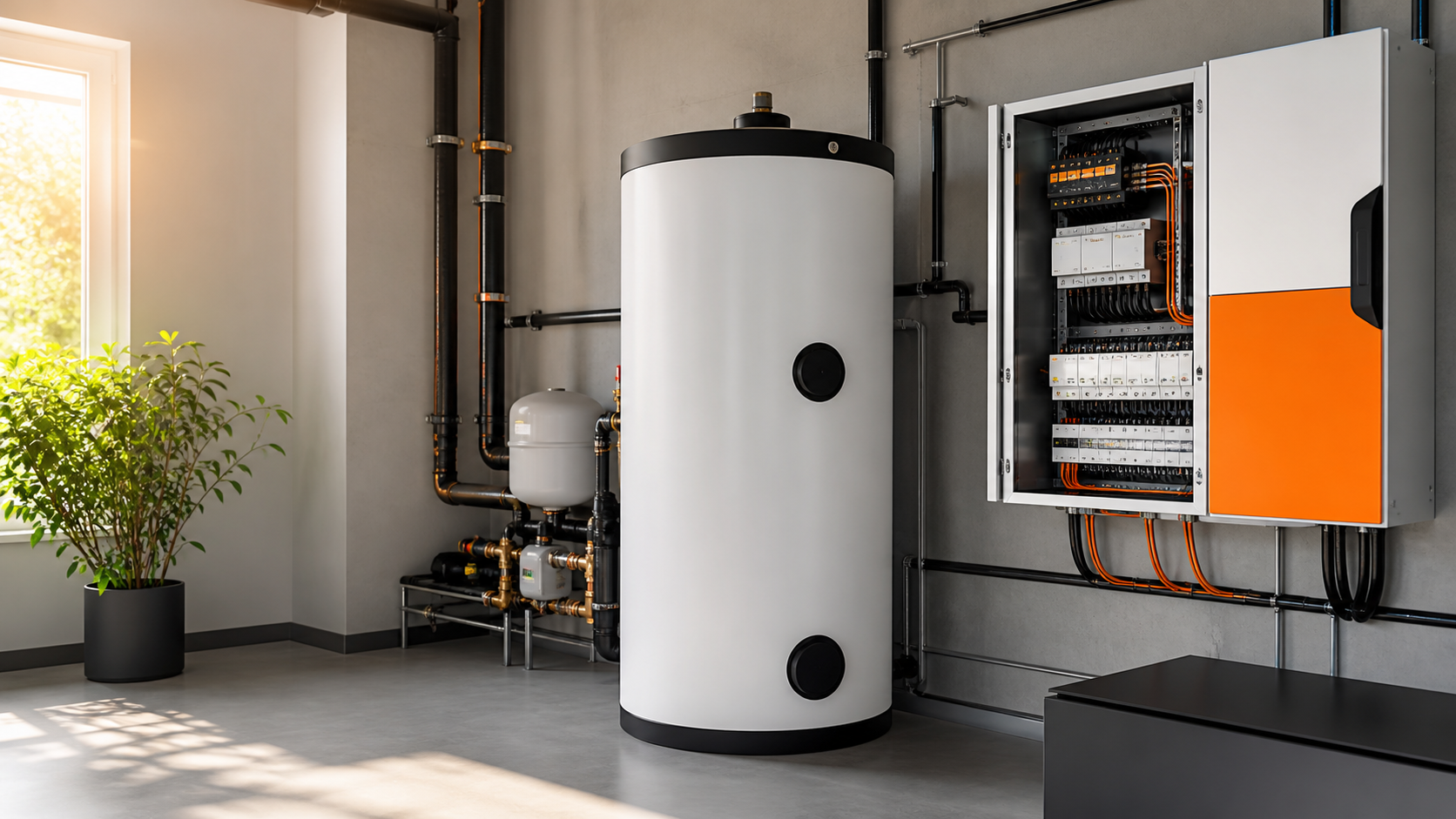
Electricity systems need more than additional generation. They also need demand that can move away from congested or expensive hours. The International Energy Agency identifies demand response as an underused source of flexibility and specifically points to space heating, cooling and water heating as loads that can often shift in time.
That does not mean reducing comfort. It means producing and storing heat before it is required. A water cylinder, fireclay storage heater or industrial thermal store can charge during a useful electricity window and deliver the same thermal service later.
Why controllable heat matters
Electrical batteries are valuable because they can return electricity to many kinds of equipment. Thermal stores are more specialised, but that specialisation can be an advantage when the final requirement is heat. Converting electricity to stored heat directly can preserve battery capacity for lighting, electronics, motors and backup circuits.
The best control strategy considers photovoltaic surplus, tariffs, forecast demand and the thermal limits of the building or process. A simple timer may help, but a controller that reacts to real surplus can reduce unwanted grid export and avoid charging from the grid at the wrong time.
Flexibility has physical limits
Every thermal system has a maximum storage temperature, heat-loss rate and recovery time. Comfort and process requirements come first. A heater that is too small cannot absorb a short photovoltaic peak; an oversized unit may never complete an efficient charge cycle. Location, electrical connection and ventilation also affect the design.
The same discipline applies to batteries. The IEA notes that utility-scale battery project costs fell substantially in 2024, but lower hardware prices do not remove the need for correct sizing and control. A poorly coordinated system can still export surplus while storage capacity sits unavailable.
Design electricity and heat together
- Measure when surplus electricity is actually available.
- Identify which later loads must remain electrical.
- Calculate the useful thermal demand and safe storage window.
- Choose charging power that fits the connection and surplus profile.
- Define priorities for battery charging, thermal charging and grid export.
WodaTherm treats batteries and thermal accumulation as complementary tools. The goal is not to force every kilowatt-hour into one technology, but to place it where it creates the most useful service.
Primary source: International Energy Agency · source language: English · published: 2026-02-06. This is an original WodaTherm™ briefing, not a copy of the source publication.