
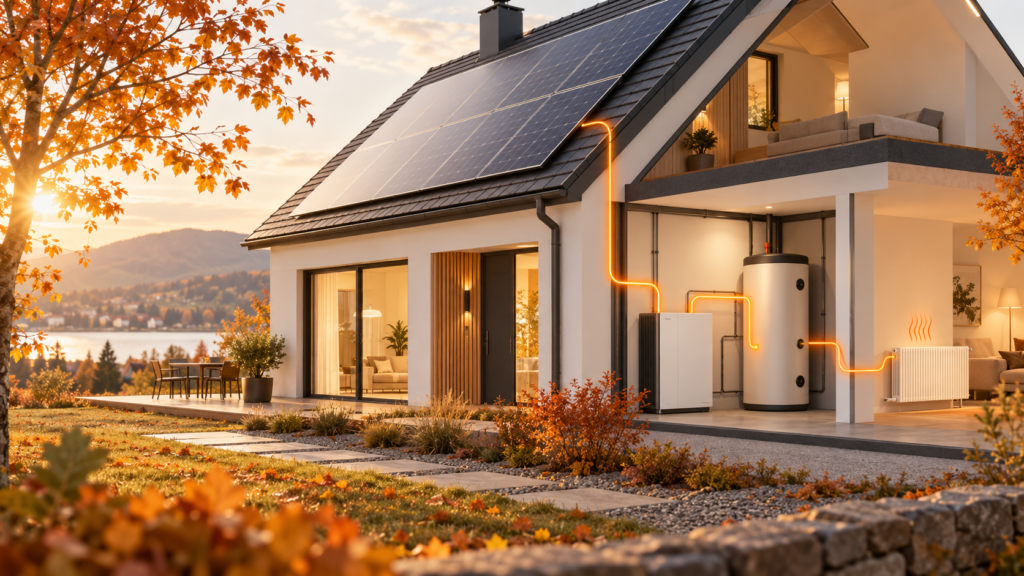
Solar electricity during the day, light and comfortable warmth in the evening. A battery and thermal storage can serve different, complementary needs in the same home. Their value comes from control that reflects actual consumption and household priorities.
The heating season changes a home’s daily rhythm. Evening demand grows, photovoltaic output follows the weather, and warmth is often needed after sunset. A useful approach is to give available energy the right job: keep some as electricity and prepare some as heat for later use.
Why this matters in 2026
The IEA’s Global Energy Review 2026 reports 108 GW of new battery storage installations worldwide in 2025, a 40% increase over the previous year. The figure in GW describes installed power capacity. A second relevant trend appears in Electricity 2026, which highlights the potential to control and shift heating and other building loads.
For an individual home, these trends raise a practical design question: how should generation, the electrical battery and heat be coordinated? The guidance below is WodaTherm™’s editorial interpretation for practical home energy planning.
Electricity for the evening, stored heat for comfort
A battery keeps energy available for appliances, lighting and other electrical needs. Thermal storage prepares heat when energy is available and releases it later. Depending on the building, a suitable solution may be a buffer connected to the heating system or an electric storage heater selected for a particular room.
The two can work together. A controller might preserve the planned battery reserve for the evening and direct further useful surplus towards heat. The sequence depends on indoor temperature, available storage capacity, the generation forecast, connection limits and the actual tariff.
A simple example: one kilowatt for two hours
A usable surplus of 1 kW lasting two hours represents 2 kWh of electrical energy. Subject to the system’s capabilities, that energy can charge the battery or prepare heat.
This example illustrates a simple energy calculation. Losses, available capacity and control affect the useful outcome. A partial-storage heater releases some heat into the room while it charges. Design therefore needs to account for both the incoming energy and when the home will use it.
Five inputs for a better design
- Generation and demand profiles. Preferably 15-minute records that reveal daytime surplus and evening peaks.
- Heating requirements. Heat loss, the existing heating method and the comfort required in each room.
- Battery and inverter capabilities. Usable capacity, charging power, available controls and the intended operating reserve.
- Tariff and connection conditions. Actual import and export prices, power limits and any conditions for timed operation.
- Coordinated control. Metering at the connection point, verified compatibility and clear priorities for comfort, reserve and surplus use.
Start with the home, then choose the equipment
A well-designed combination gives each kilowatt-hour a useful purpose. The priority may be evening electricity, heat preparation or making better use of short sunny periods. Final design and electrical installation should follow the documentation for the selected equipment and assessment by a qualified professional.
Explore battery storage and electric storage heating at WodaTherm™. Use our contact form to share the inverter model, consumption profile and heating method so we can review an appropriate configuration.
Sources checked on 7 October 2026: IEA — Global Energy Review 2026: Battery storage; IEA — Electricity 2026: Flexibility. Original sources in English; independently edited WodaTherm™ editorial copy. The opening image is an AI-created conceptual illustration.